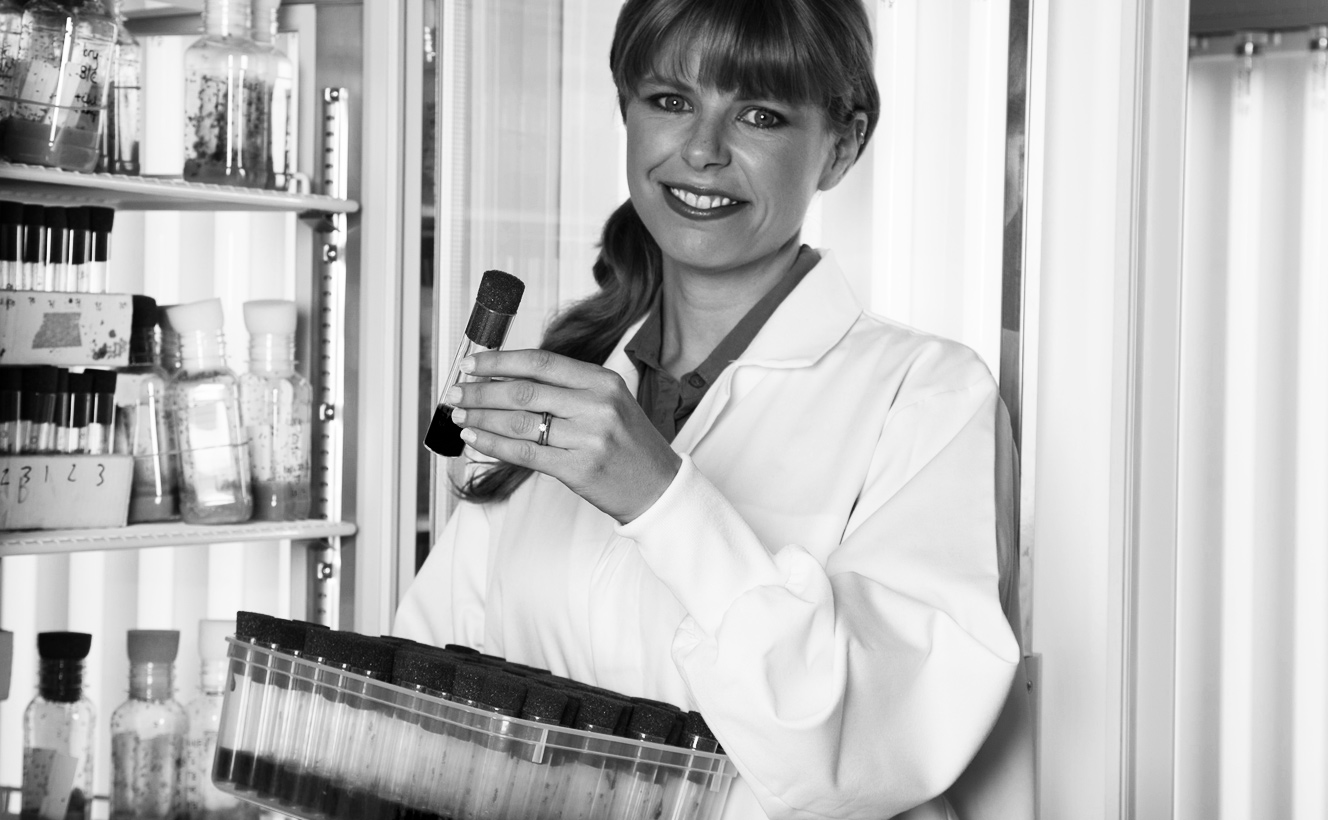
Congratulations to Postdoctoral fellow Dr Belinda van Heerwaarden who has been awarded an Australian Research Council (ARC) Discovery Early Career Researcher Award (DECRA).
The DECRA scheme supports promising early-career researchers and promotes enhanced opportunities for diverse career pathways.
Published in: Proceedings of the Royal Society B, volume 281, number 1790 (September 2014)
Abstract
Species with restricted distributions make up the vast majority of biodiversity.
Recent evidence suggests that Drosophila species with restricted tropical distributions lack genetic variation in the key trait of desiccation resistance. It has therefore been predicted that tropically restricted species will be limited in their evolutionary response to future climatic changes and will face higher risks of extinction. However, these assessments have been made using extreme levels of desiccation stress (less than 10% relative humidity (RH)) that extend well beyond the changes projected for the wet tropics under climate change scenarios over the next 30 years.
Here, we show that significant evolutionary responses to less extreme (35% RH) but more ecologically realistic levels of climatic change and desiccation stress are in fact possible in two species of rainforest restricted Drosophila. Evolution may indeed be an important means by which sensitive rainforest-restricted species are able to mitigate the effects of climate change.
Citation
van Heerwaarden, B Sgrò CM (2014) Is adaptation to climate change really constrained in niche specialists? Proceedings of the Royal Society BPDFDOI
Congratulations to ARC Postpocoral fellow Dr Vanessa Kellerman who has been awarded a coveted L’Oréal Australia For Women in Science Fellowship.
The $25,000 fellowship is awarded annually to three female scientists with no more than five years of post-doctoral experience. The fellowships are awarded to women who have shown scientific excellence in their career, and are designed to help women scientists consolidate their careers and rise to leadership positions in science.
Dr Vanessa Kellerman has been awarded one of three L’Oréal Fellowships allocated annually to exemplary women in science.
Vanessa is working with Drosophila fruit fly species from Tasmania to tropical Queensland as model organisms for investigating the capacity of species to adapt to climate change. She has already demonstrated that tropical flies are more vulnerable to change in the long term; they don’t have the genetic capacity to evolve quickly. Now, with her L’Oréal Fellowship, she will explore how flexible they are in the short term — how individual insects can respond to change during their lifetimes.
“The thinking is that if the speed of climate change is quicker than genetic change, then perhaps immediate changes in the body’s thermal tolerance can hold the fort, while evolution catches up” Vanessa said.
“Plasticity is a real hole in our knowledge of adaptation. No one has really set out to examine the variation in plasticity over so many species. The L’Oréal Fellowship will allow me to scope out the project and determine what works.”
Authors: Shaun Blackburn, Belinda van Heerwaarden, Vanessa Kellermann and Carla M Sgrò
Published in: Journal of Experimental Biology, volume 217, number 11 (June 2014)
Abstract
Thermal tolerance is an important factor influencing the distribution of ectotherms, but we still have limited understanding of the ability of species to evolve different thermal limits.
Recent studies suggest that species may have limited capacity to evolve higher thermal limits in response to slower, more ecologically relevant rates of warming. However, these conclusions are based on univariate estimates of adaptive capacity.
To test these findings within an explicitly multivariate context, we used a paternal half-sibling breeding design to estimate the multivariate evolutionary potential for upper thermal limits in Drosophila melanogaster. We assessed heat tolerance using static (basal and hardened) and ramping assays.
Additive genetic variances were significantly different from zero only for the static measures of heat tolerance. Our G matrix analysis revealed that any response to selection for increased heat tolerance will largely be driven by static basal and hardened heat tolerance, with minimal contribution from ramping heat tolerance.
These results suggest that the capacity to evolve upper thermal limits in nature may depend on the type of thermal stress experienced.
Citation
Blackburn S, van Heerwaarden B, Kellermann V, Sgrò CM (2014) Evolutionary capacity of upper thermal limits: beyond single trait assessments. Journal of Experimental BiologyPDFDOI
As we pour heat-trapping gases into the air, we’re running an experiment. We’re going to see what a rapidly changing climate does to the world’s biodiversity — how many species shift to new ranges, how many adapt to their new environment and how many become extinct.
We don’t have a very good idea of how the experiment will turn out. Scientists are coming to appreciate that there’s a lot about how climate affects life that they still don’t understand. That’s true, it turns out, even for species that scientists have been studying carefully for years.
Early experiments on Drosophila birchii suggested it lacked the genetic potential to evolve in response to climate change. Image credit: Andrew Weeks
In the early 2000s, Ary A. Hoffmann, a biologist then at La Trobe University in Melbourne, Australia, wondered how the many species in tropical rain forests would cope when their humid environment dried out.
It was conceivable that some species might adapt. Over the generations, natural selection ought to favor the individuals that could survive longer in dry air. Over time, the whole population should become more resistant.
Within hours, the flies were dying off. But Dr. Hoffmann rescued those that survived longest and let them breed. He repeated this procedure over 50 generations.
But at the end of the experiment, the flies were no more resistant to dry air than their forebears. The flies seemed to lack the genetic potential to evolve. Those results suggested that if the rain forest home of Drosophilia birchii loses its high humidity, the flies will die off.
When Dr. Hoffmann and his colleagues ran similar tests on other species of flies, they had equally grim results. Flies that had limited ranges in the tropics showed little potential to adapt to extremely dry conditions.
Recently, two of Dr. Hoffmann’s collaborators — Belinda van Heerwaarden and Carla M. Sgrò of Monash University — decided to rerun the experiment, but with a crucial twist.
Rather than expose the flies to 10 percent relative humidity, Dr. van Heerwaarden and Dr. Sgrò tried 35 percent. That’s still far drier than the moist air of rain forests, but it’s not the aridity one might encounter on a summer day in Death Valley.
“It’s a humidity that’s more relevant to the predictions for how dry the environment would become in the next 30 to 50 years,” Dr. Sgrò said.
Even at 35 percent humidity, Dr. van Heerwaarden and Dr. Sgrò found, the flies fared badly. On average, they died after just 12 hours.
But Dr. van Heerwaarden and Dr. Sgrò found that some of the flies survived a little longer than others. By comparing different families of flies, they discovered that the difference in the flies’ resistance was influenced by their genes. That’s not what the first experiment had suggested.
“Our first thought was, ‘Oh my God, what’s happening here?’” Dr. Sgrò said.
She and Dr. van Heerwaarden wondered if these genes might provide a chance for the flies to adapt to a drier climate after all. To find out, they rescued the longest-living flies and let them breed.
Unlike the flies in the earlier studies, it didn’t take long for these to start evolving. After just five generations, one species was able to survive 23 percent longer in 35 humidity.
“When you change the environment, you get a totally different answer,” Dr. van Heerwaarden said.
The new study, published in Proceedings of the Royal Society B, hints that the flies resist drying out in an unexpected way. The genes that help them temporarily survive extreme dryness are not the same as those that help them resist more moderate conditions. The second set of genes enables them to adapt.
Whereas the earlier research offered a bleak prospect for species’ adaptation to climate change, the new study may offer a bit more hope. “This result suggests that some species might have the capacity to persist for a little bit longer,” Dr. Sgrò said.
“It is good to see that there might be some adaptive potential,” said Dr. Hoffmann, who was not involved in the new study. “Anything is useful.”
But he questioned just how much help their evolution might be. While the flies might be able to start adapting to drier conditions, they may not be able to do it quickly enough to keep pace with the change. “I think the warning in the original work still stands,” he said.
Some other scientists have documented the capacity for species to evolve in response to climate change, said Andrew Hendry, an evolutionary biologist at McGill University. But it’s rare for scientists to examine species under a range of conditions, as Dr. van Heerwaarden and Dr. Sgrò have done.
Dr. Hendry said the new study adds to growing evidence that many species will find ways to evolve in response to climate change, if only a little. “Evolution will help, there’s no question,” Dr. Hendry said. “But it might not help enough.”
Authors: Jonathan MP Davis, Belinda van Heerwaarden, Carla M Sgrò, Jennifer A Donald, and Darrell J Kemp
Published in: Evolutionary Ecology, volume 28, issue 3 (May 2014)
Abstract
Species with restricted distributions make up the vast majority of biodiversity.
Recent evidence from Drosophila suggests that species with restricted distributions may simply lack genetic variation in key traits, limiting their ability to adapt to conditions beyond their current range. Specifically, tropical species of Drosophila have been shown to have low means and low genetic variation for cold tolerance and desiccation tolerance.
It has therefore been predicted that these species will be limited in their response to future climatic changes. However whether these results extend beyond Drosophila is not known.
Eurema hecabe, one of three congeneric butterflies with contrasting Australian distributions. Image credit: AntanO [CC-BY-SA-3.0] via Wikimedia Commons.
We assess levels of quantitative genetic variation for cold tolerance and body size in three species of butterfly from the genus Eurema that can be classified as tropically restricted (E. laeta), tropical/subtropical (E. hecabe) and widespread (E. smilax) in their distribution.
Compared to the more widely distributed species, we show that the tropically restricted E. laeta has significantly lower mean cold tolerance and lacks genetic variation for this trait. Thus, we empirically confirm in non-model organisms that low levels of genetic variation in a key ecological trait may play a role in limiting the distribution of tropically restricted species.
Citation
Davis J, van Heerwaarden B, Sgrò CM, Donald J, Kemp DJ (2014) Low genetic variation in cold tolerance linked to species distributions in butterflies. Evolutionary EcologyPDFDOI
Authors: Fiona E Cockerell, Carla M Sgrò, and Stephen W McKechnie
Published in: Journal of Insect Physiology, volume 60 (January 2014)
Highlights
We investigate heat tolerance in D. melanogaster reared at 18 and 25 °C from populations collected over a range of latitudes.
Tropical flies are more heat tolerant than temperate region flies after heat hardening.
Total protein synthesis rates vary clinally depending on temperature conditions.
Levels of a major transcript of the heat-stress hsr-omega gene vary clinally.
Abstract
The occurrence of climatic adaptation in Drosophila melanogaster is highlighted by the presence of latitudinal clines in several quantitative traits, particularly clines in adult heat knockdown tolerance that is higher in tropical populations. However the presence of latitudinal patterns in physiological characteristics that may underlie these traits have rarely been assessed.
Protein synthesis has been implicated as an important physiological process that influences thermal tolerance, and this has not been examined in a clinal context.
Here, we characterise latitudinal variation in D. melanogaster from eastern Australia in both adult heat knockdown tolerance and rates of protein synthesis following rearing at both 25 °C, approximating summer conditions, and 18 °C, approximating winter development.
We also examined clinal variation in the predominant nuclear transcript of the heat-inducible RNA gene hsr-omega, which has been implicated in regulating protein synthesis.
We find significant clines in heat-hardened tolerance when cultured at both 18 and 25 °C — tolerance increased towards the low latitude tropics. Rates of protein synthesis measured in ovarian tissue also associated negatively with latitude, however the presence of the clines depended on rearing temperature and heat stress conditions.
Finally, omega-n levels measured without heat stress showed a positive linear cline. When measured after a mild heat stress higher levels of omega-n were detected and the clinal pattern became parabolic — mid-latitude populations had lower levels of the transcript.
While congruent latitudinal trends were detected for these three traits, only a low level of positive association was detected between protein synthesis and thermal tolerance providing little evidence that these traits are related at the level of cellular physiology. However the new clinal patterns of protein synthesis and hsr-omega variation suggest that these variables exert important influences on traits involved with latitudinal climatic adaptation.
Citation
Cockerell FE, Sgrò CM, McKechnie SW (2014) Latitudinal clines in heat tolerance, protein synthesis rate and transcript level of a candidate gene in Drosophila melanogaster. Journal of Insect PhysiologyPDFDOI
Authors: Jesper S Bechsgaard, Ary A Hoffmann, Carla M Sgrò, Volker Loeschcke, Trine Bilde, and Torsten N Kristensen
Published in: PLOS ONE, volume 8, issue 2 (February 2013)
Abstract
The evolutionary history of widespread and specialized species is likely to cause a different genetic architecture of key ecological traits in the two species groups. This may affect how these two groups respond to inbreeding.
Here we investigate inbreeding effects in traits related to performance in 5 widespread and 5 tropical restricted species of Drosophila with the aim of testing whether the two species groups suffered differently from inbreeding depression. The traits investigated were egg-to-adult viability, developmental time and resistance to heat, cold and desiccation.
Our results showed that levels of inbreeding depression were species and trait specific and did not differ between the species groups for stress resistance traits. However, for the life history traits developmental time and egg-to adult viability, more inbreeding depression was observed in the tropical species.
The results reported suggest that for life history traits tropical species of Drosophila will suffer more from inbreeding depression than widespread species in case of increases in the rate of inbreeding e.g. due to declines in population sizes.
Citation
Bechsgaard JS, Hoffmann AA, Sgrò CM, Loeschcke V, Bilde T, Kristensen TN (2013) A comparison of inbreeding depression in tropical and widespread Drosophila species, PLoS ONEPDFDOI


![Eurema hecabe, one of three congeneric butterflies with contrasting Australian distributions. Image credit: AntanO [CC-BY-SA-3.0] via Wikimedia Commons.](https://carlasgrolab.org/wp-content/uploads/2014/09/eurema_hecabe.jpg)
 Genetics, evolution, biodiversity and climate change
.JPG)